
Rolled steel T sections are structural steel sections with a T-shaped cross-section, consisting of a flange and a web. They are produced in standardized sizes so that engineers can select a suitable section based on its dimensions and sectional properties. Tee sections are used in structural and fabrication work where the shape of the member and its strength and stiffness characteristics are suitable for the application.
The properties of a rolled steel T section include weight per metre, sectional area, depth of section, flange width, flange thickness, web thickness, centre of gravity, moment of inertia, and radius of gyration. These values are useful for section comparison and for engineering calculations involving bending, stiffness, buckling, and load-carrying behaviour.
The following Properties of Rolled Steel Tee Sections table provides commonly used T-section designations along with their important dimensions and sectional properties. The data can be used as a reference when selecting or comparing sections during preliminary structural design. For final design, the selected section should be checked against the applicable material specification, loading conditions, design requirements, and relevant standards.
Properties of Rolled Steel T Section
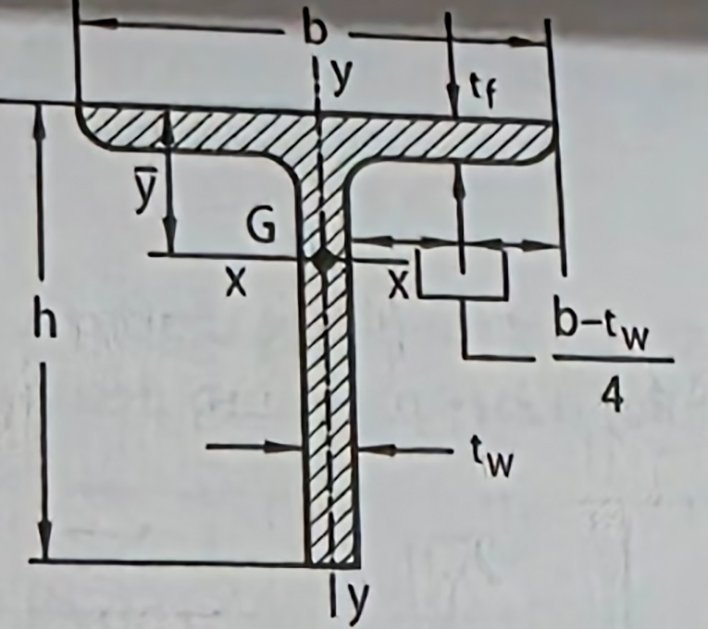
| Designation | Weight per metre (kgf) | Sectional Area (cm²) | Depth h (mm) | Flange Width b (mm) | Flange Thickness t_f (mm) | Web Thickness t_w (mm) | Centre of Gravity ȳ (cm) | I_xx (cm⁴) | I_yy (cm⁴) | k_xx (cm) | k_yy (cm) |
|---|---|---|---|---|---|---|---|---|---|---|---|
| ISNT 20 | 1.1 | 1.45 | 20 | 20 | 4.0 | 4.0 | 0.60 | 0.5 | 0.2 | 0.58 | 0.41 |
| ISNT 30 | 1.8 | 2.26 | 30 | 30 | 4.0 | 4.0 | 0.82 | 1.8 | 0.8 | 0.89 | 0.59 |
| ISNT 40 | 3.5 | 4.45 | 40 | 40 | 6.0 | 6.0 | 1.14 | 6.1 | 2.9 | 1.18 | 0.81 |
| ISNT 50 | 4.4 | 5.66 | 50 | 50 | 6.0 | 6.0 | 1.35 | 12.3 | 5.7 | 1.47 | 1.01 |
| ISNT 60 | 5.4 | 6.85 | 60 | 60 | 6.0 | 6.0 | 1.56 | 21.4 | 9.7 | 1.77 | 1.19 |
| ISNT 75 | 10.0 | 6.90* | 75 | 75 | 9.0 | 9.0 | 2.04 | 62.0 | 29.2 | 2.21 | 1.52 |
| ISNT 100 | 14.9 | 18.97 | 100 | 100 | 10.0 | 10.0 | 2.62 | 163.9 | 76.8 | 2.94 | 2.01 |
| ISNT 150 | 22.7 | 28.88 | 150 | 150 | 10.0 | 10.0 | 3.61 | 541.1 | 250.3 | 4.33 | 2.94 |
| ISDT 100 | 8.1 | 10.37 | 100 | 50 | 10.0 | 5.8 | 3.03 | 99.0 | 9.6 | 3.09 | 0.96 |
| ISDT 150 | 15.7 | 19.96 | 150 | 75 | 11.6 | 8.0 | 4.75 | 450.2 | 37.0 | 4.75 | 1.36 |
| ISLT 200 | 28.4 | 36.22 | 200 | 165 | 12.5 | 8.0 | 4.78 | 1267.8 | 358.2 | 5.92 | 3.15 |
| ISLT 250 | 37.5 | 47.75 | 250 | 180 | 14.1 | 9.2 | 6.40 | 2774.4 | 532.0 | 7.62 | 3.34 |
| ISMT 50 | 5.7 | 7.30 | 50 | 75 | 7.2 | 4.0 | 0.96 | 9.7 | 20.4 | 1.15 | 1.67 |
| ISMT 62.5 | 6.5 | 8.30 | 62.5 | 75 | 7.6 | 4.4 | 1.30 | 21.3 | 21.9 | 1.60 | 1.62 |
| ISMT 75 | 7.5 | 9.50 | 75 | 80 | 7.6 | 4.8 | 1.67 | 40.1 | 26.3 | 2.05 | 1.66 |
| ISMT 87.5 | 9.7 | 12.31 | 87.5 | 90 | 8.6 | 5.5 | 1.98 | 72.6 | 42.5 | 2.43 | 1.86 |
| ISMT 100 | 12.7 | 16.16 | 100 | 100 | 10.8 | 5.7 | 2.13 | 115.8 | 75.0 | 2.68 | 2.15 |
| ISHT 75 | 15.3 | 19.49 | 75 | 150 | 9.0 | 8.4 | 1.62 | 96.2 | 230.2 | 2.22 | 3.44 |
| ISHT 100 | 20.0 | 25.47 | 100 | 200 | 9.0 | 7.8 | 1.91 | 193.8 | 497.3 | 2.76 | 4.42 |
| ISHT 125 | 27.4 | 34.85 | 125 | 250 | 9.7 | 8.8 | 2.37 | 415.4 | 1005.8 | 3.45 | 5.37 |
| ISHT 150 | 29.4 | 37.42 | 150 | 250 | 10.6 | 7.6 | 2.66 | 573.7 | 1096.8 | 3.92 | 5.41 |
Note:
- ISNT = Indian Standard Normal Tee Bars
- ISDT = Indian Standard Deep Legged Tee Bars
- ISLT = Indian Standard Slit Light Weight Tee Bars
- ISMT = Indian Standard Slit Medium Weight Tee Bars
- ISHT = Indian Standard Slit Bars from H-Section
What Material Are Rolled Steel T Sections Made From?
Rolled steel T sections are generally manufactured from structural steel. The steel grade used for a particular section depends on the applicable material specification, required strength, and intended application. The Tee section designation identifies the type and size of the section; it does not, by itself, specify the steel grade.
For engineering work, the material grade should be confirmed from the applicable material specification and project requirements. The specified dimensions and sectional properties should also be verified against the relevant section standard before the section is used for final design or fabrication.
Where Are Rolled Steel T Sections Used?
Rolled steel T sections are used in structural and fabricated assemblies where a T-shaped member is suitable for the required application. Common applications include:
- Structural supports
- Brackets and frames
- Trusses and bracing members
- Machinery and equipment structures
- Platforms and supporting structures
- General fabrication work
- Reinforcement and structural components
The selection of a T section depends on factors such as the applied load, member length, support conditions, required strength, and the sectional properties required for the design.
Conclusion
The section properties table provides a convenient reference for comparing different rolled steel T-section sizes and types. Properties such as cross-sectional area, weight per metre, moment of inertia, and radius of gyration can be used as basic data for engineering calculations and section comparison. For actual design work, the selected section should be checked for the specific loading, material grade, member condition, and applicable design requirements.